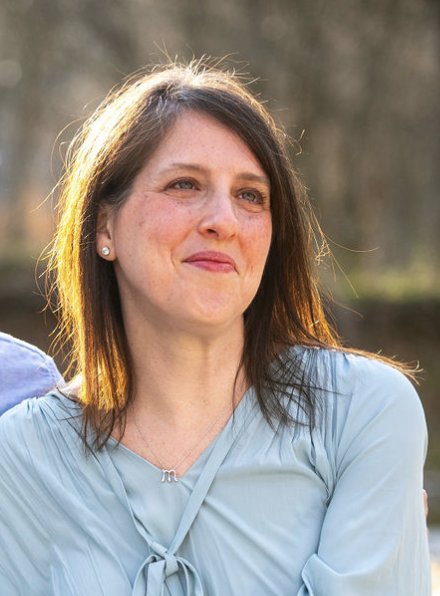
Photo by Laura Chase de Formigny - “Looking at my daughter”
By Holly Leber Simmons
You would think I’d have been ecstatic to finish active cancer treatment.
After a 4-month clinical trial, a double mastectomy, chemotherapy, and 25 sessions of radiation therapy , logic – nay, sanity – dictates I should have been delighted to leave Sibley Memorial Hospital and the Sidney Kimmel Comprehensive Cancer Center at Johns Hopkins in my rearview mirror like the Road Runner fleeing Wile E. Coyote.
Instead, I felt… unmoored. Floundering. All at sea.
Apparently, these feelings are par for the course (pardon the mixture of nautical and golf metaphors). Survivors I know say the first few years after treatment are emotionally harder and more anxiety-producing than surgery or chemo.
Want to know one of the most annoying things you can say to someone who recently completed cancer treatment?
“So, it’s over, right? You’re all done!”
No. No. Being done with active treatment doesn’t mean being done with cancer. Physically? My hair and eyebrows were missing, my skin was burnt, I was tired and achy, my guts were all messed up, and my memory is still… I forget what’s wrong with my memory. Many patients continue with adjuvant, or maintenance, therapies to help prevent recurrence, or get regular labs and scans, depending on the type of cancer and other factors. I take two kinds of pills and, prior to a 2026 salpingo-oopherectomy, had monthly injections to suppress my ovaries so they wouldn’t produce estrogen. I’ll do you the kindness of not including a picture of the needle.
And emotionally? Definitely not done with cancer, or it’s not done with me. I personally have a veritable Jackson Pollock painting of cancer-adjacent anxiety inside me – frenetic, unpredictable, disorderly, often overwhelming, and frankly very annoying.
“I think it’s important to acknowledge how scary it can be to be done with treatment, particularly for younger survivors,” my friend Beth, who fought triple-negative breast cancer in 2020, told me. “That part doesn’t get much attention, and it’s hard when the world wants you to be Susie Sunshine Survivor.”
Cancer is a trauma to the body, yes, but also to the mind. Even the word “survivor” feels uneasy. It’s still early. Am I jumping the gun here?
Trying to figure out this next stage of life, or search for a “new normal” as Sibley social worker Janie Regler said, can be terrifying to navigate.
That is why a program like the Sibley Survivorship Education Series: Stronger and Healthier Together is essential for patients who are making the transition from active treatment.
When I took part in the series in 2024, it was run by Pamela Goetz, OPN-CG, Survivorship Program Manager at the Center for Patient and Family Services at the Kimmel Cancer Center at Sibley, and Jill Studely, Integrative Nutrition Health Coach.
I met Pam shortly before I began treatment at Sibley. She took me through all the support services and offerings that were available, from yoga classes to sessions with a counselor, and resources to help me and my husband talk to our daughter, then 4, about my diagnosis. She assured me that I would be cared for as a whole person, not just as a cancer-carrying entity, and I have found this to be the case across my experience.
Pam retired in April 2026, and Margo Ten Broeck Calkin, National Capital Region Coordinator-Oncology, now spearheads the program alongside Jill.
“The transition after cancer treatment can be one of the most challenging parts of the cancer experience,” said Margo. “While medical appointments slow down and outside support may fade, physical side effects, emotional concerns, and questions about “what’s next” often continue.”
The first thing to know is this is not a support group. It certainly felt like a supportive environment, even virtually, but the point isn’t to explore our emotions about having cancer. Instead, this is an informative series. After the first introductory session, each subsequent week is focused on a different topic, with one or two guest speakers.
For instance, in one session, cancer rehabilitation specialist Dr. Jessica Engle, DO, spoke about fatigue and lifestyle changes following cancer treatment, while Nurse Joyce Hamba discussed “finding zest after a cancer diagnosis.” Hate to tell you this, but cancer meds are not an aphrodisiac.
Not all the sessions were strictly talk-based. During week 3, Mind and Body Movement, we were guided through some easy yoga poses, meditative deep breathing, and basic reiki hand positions, courtesy of yoga for cancer teacher Erika Newell, meditation instructor Chris Montone, and Reiki Master Geralyn Lutty, respectively.
After the planned remarks, or activities, each of the guests took questions from participants. The organizers kept things orderly by making use of the “raise hand” function in Zoom. While the group was a mix of genders, ages, and cancers, most of the questions felt pretty universal. It’s not hard to connect with the anxiety of cancer recurrence, or the struggle to prioritize health in the midst of work and family obligations.
Following each session, a copy of the presenters’ PowerPoint slides, or other information they’d offered, was emailed to us. By the end of the six weeks, we had all amassed a good collection of information.
In addition to the information we learned during the six weeks, the Survivorship program is also a way to be introduced to some of the specialists whose work within the oncology department is focused on guiding patients through the process of recovery. I see Dr. Engle on matters ranging from chemo brain to medicine-related weight gain. Nurse Hamba sat down with me for a very open one-on-one discussion about sex. Jill offers each participant three private coaching sessions to focus on individual needs.
Something Jill focused on with me is my anxiety. “Capitalize on the parts of your mind and energy that serve you well,” she advised.
That includes encouraging me to write about my experience with the survivorship program as a part of this whole cancer misadventure (I flat-out refuse to call it a “journey”). Which means if you’ve read this far and you would like your time back, you can blame her.
All joking aside though, with hand on heart I cannot say enough good things about the patient support programming and people at the Kimmel Cancer Center at Sibley, in addition to the doctors, nurses, and administrators. There’s nothing that can make cancer – and post-cancer – not terrifying and stressful, but I feel so very well-cared-for here.
And for that, I am forever grateful.
Holly Leber Simmons is a mother, wife, and professional writer. She was diagnosed with Stage 2A HR+ HER2- breast cancer in September 2022, at age 42. In her real life, Holly enjoys tending to her community garden plot and doing cooking experiments with the things she grows. Holly blogs about her experiences with breast cancer here (contains NSFW language)